

Bridging EV Charging Deserts: Powering Victoria’s Regional Transit Spine - (Part 2 of 5)
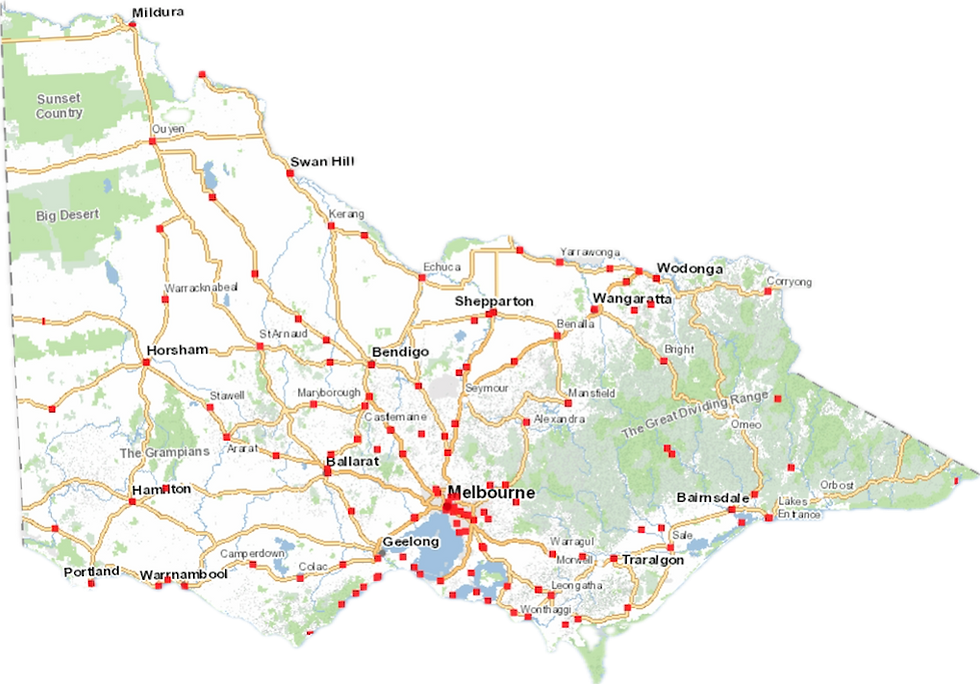
Victoria’s transition to electric mobility in regional areas is hindered by "charging deserts" along high-volume corridors. To unlock interstate travel and regional tourism, the state must shift from urban-centric clusters to a dual-tier "charging spine." By strategically placing ultra-fast hubs on highways and fast chargers in amenity-rich towns, Victoria can eliminate EV charger anxiety.
Key Points
Arterial Ultra-Fast Spines: Prioritizing 150kW+ charging stations directly located on major highways (Hume, Princes, Western, Calder) to facilitate rapid 15–30 minute turnarounds for long-haul interstate transit.
Tiered Charging Logic: Implementing a "Dual-Speed" network—Ultra-fast hubs for high-speed transit and 50kW–150kW fast chargers in high-visitation regional towns to support tourism and local economies.
Tourism & Economic Integration: Siting fast chargers in amenity-rich destinations like the Great Ocean Road and Alpine regions to encourage "charger tourism," boosting local spending while drivers recharge.
Reliable Range Confidence: Building a holistic, future-proofed network that ensures regional and interstate travel is a seamless experience rather than a "calculated risk" for Melbourne-based and interstate drivers.
The Current State of Victorian EV Infrastructure
The electric vehicle (EV) charging landscape in regional Victoria remains significantly underdeveloped. Currently, over 90% of regional charging sites offer a maximum of four bays (2 chargers), with the vast majority limited to 50kW units. Users often experience long wait times during peak times, with instances of numerous cars waiting for the single charger. In addition, some chargers will split power when two cars are connected, reducing the charging speed to half of its charging speed rate per car, which increases charging time and, of course, wait times. These specifications fall well short of the requirements for seamless long-distance travel.
Whilst Tesla serves as a notable exception—typically deploying between 6 and 12 ultra-fast chargers per site—a critical geographical gap persists. Both Tesla and its competitors have largely failed to establish a consistent presence along Victoria’s or indeed all of Australia's, primary highway corridors, leaving key transit routes underserved.
Key Elements of a "Perfect" EV Charging Infrastructure.
The substantial distances involved in interstate travel within and through Victoria necessitate a few Ultra fast charging stops. For instance, the journey from Melbourne to Sydney ( around 900Kms) or Melbourne to Adelaide (just over 700 kms) would typically require at least 2 to 3 fast charging sessions to ensure comfortable travel, with stops strategically planned before battery levels get below 5%, which is around the same distance when the low fuel lights come on in an ICE vehicle. For shorter but still significant regional routes like Melbourne to Mildura (around 500 km), 1 or 2 fast charging stops would be sufficient. Fast chargers offer considerable range replenishment, which is beneficial for maintaining travel efficiency on long drives.
In most cases, a 50kW DC charger can add approximately 200 to 250kms of driving range per hour charged, while higher-power chargers (150kW and above) can double that distance in a shorter timeframe, if the car's system can handle the higher charging rate. This means that a relatively short stop of 15-30 minutes can provide a substantial range boost, minimizing downtime at each stop for travelers.
Needless to say, EV charging infrastructure in regional Victoria goes beyond simply installing charging stations. It requires a holistic approach that encompasses strategic placement, collaborative partnerships, technological integration, and a focus on long-term sustainability.
The following elements are crucial:
1. Strategic Placement of Ultra-Fast Charging Stations. (= or > than 150kw chargers)
To ensure peak efficiency, EV infrastructure must be positioned strategically. As mentioned, currently, regional Victoria lacks sufficient charging density, specifically along its primary highway corridors; rectifying this is paramount to supporting interstate mobility and regional connectivity. Enhancing these routes will reduce transit times and provide the reliable "range confidence" necessary for travel between Melbourne and the state's outer reaches.
Interstate corridor or state’s outer reach EV ULTRA-FAST charging stations preferred locations ( all to be located along the highway, not in a town )
Hume Freeway/Highway(M31/A31): The primary arterial connecting Melbourne to Sydney. This is a high-traffic route for both commercial and private vehicles.
Key locations: Benalla, Glenrowan, Wangaratta, Wodonga (Bordertown).
Princes Freeway/Highway (M1/A1): Connecting Melbourne to destinations in Gippsland (east) and Geelong/South Australia (west). This highway serves significant coastal tourism and interstate freight.
Key Towns/Stops (East): Warragul, Traralgon, Sale, Bairnsdale, Lakes Entrance. (West): Geelong, Colac, Camperdown, Warrnambool, Portland, Mount Gambier (SA).
Western Freeway/Highway (M8/A8): Connecting Melbourne to Ballarat, Ararat, Horsham, and ultimately Adelaide (South Australia).
Key Stops: Ballarat (along the highway ), Ararat, Horsham.
Calder Freeway/ Highway (M8/A79): Connecting Melbourne to Bendigo, Castlemaine, and ultimately Mildura (North-West Victoria, linking to NSW).
Key Stops: Bendigo, Charlton, Mildura.
Goulburn Valley Freeway (M39) / Goulburn Valley Highway (A39): Connecting Melbourne (via Hume Fwy) to Shepparton, Echuca, and eventually the Newell Highway in NSW.
Key Stops: Nagambie, Shepparton, Echuca.
2. Strategic Placement of Fast Charging Stations. (50kW to 150kW EV charging stations) - located in regional towns
Focus on regional towns and routes that attract a high volume of tourists. Placing chargers in these areas not only serves EV owners but also encourages longer stays and increased local spending, generating significant economic benefits. Locations with diverse amenities (eg, nearby cafes, shops, supermarkets, public toilets, tourist attractions, etc) are preferred.
High Visitation Tourism Routes & Regional Hubs
Great Ocean Road (B100): One of Australia's most iconic scenic drives, attracting significant domestic and international tourists.
Key Towns/Stops: Torquay, Lorne, Apollo Bay, Port Campbell (Twelve Apostles).
Great Alpine Road (B500): A major tourist route through Victoria's high country, popular for skiing, hiking, and scenic drives.
Key Towns/Stops: Wangaratta, Bright, Harrietville, Mount Hotham, Omeo, Bairnsdale.
Murray Valley Highway (B400): Runs along the Murray River, connecting numerous river towns popular for water sports, fishing, and historical sites.
Key Towns/Stops: Echuca, Cobram, Yarrawonga, Swan Hill, Mildura.
Mornington Peninsula Freeway / Peninsula Link (M11) & Nepean Highway (B110): A highly frequented region for day trips and holidays from Melbourne, known for sensational beaches, wineries, and dining.
Key Towns/Stops: Rosebud, Sorrento, Portsea, Dromana, Mornington.
Yarra Valley & Dandenong Ranges (Maroondah Highway B300): A renowned wine region and natural escape close to Melbourne.
Grampians (A200 Henty Highway, B160 Glenelg Highway): A major national park attraction for hiking, climbing, and Aboriginal culture.
Key Towns/Stops: Halls Gap, Stawell, Ararat.
Ballarat & Goldfields Region (Western Freeway M8, Midland Highway A300): Historic gold rush towns with significant heritage and tourism appeal.
Key Towns/Stops: Ballarat, Bendigo, Castlemaine, Maryborough.
Infrastructure Development Framework
The following table outlines the recommended charging architecture and bay allocation for representative regional locations:
Location Type | Recommended Charger Types | Recommended Number of Chargers |
Highway Mega Hubs | A- DC 50kW, B-DC 150kW+ | A- 2 to 4, B- 6 to 20+ |
Major Tourist Attraction | A- DC 50kW, B- Level 2 | A- 2 to 4, B- 6 to 10 |
Regional City Center | A- DC 50kW, B- Level 2 | A- 6 to10, B- 4 to 8 |
Hotel ( overnight acc ) | A- Level 2, B- DC 50kW (opt) | A- 1 to 20 ( depending on site accommodation no’s), B-1 to 2 |
Hotel ( PUB ) | A-Level 2, B-DC 50kW (opt) | A-5 to 10, B-1to 2 |
Technical Note: > * Level 2 Chargers: AC units ranging from 7kW to 22kW, ideal for long-dwell times.
Scalability: Initial Bay Count reflects the immediate startup requirement, while Target Scalability represents the pre-provisioned capacity enabled by upfront civil works.
Hotel bay counts vary significantly based on total accommodation capacity.
Summary
To address regional Victoria's "charging deserts," this article proposes a dual-tier "charging spine." By prioritizing ultra-fast, 150kW or higher modular hubs along major highway corridors and fast chargers in amenity-rich tourism towns, the state can eliminate charger anxiety. This scalable, proactive infrastructure strategy ensures seamless interstate transit and boosts regional economic growth.
The next post focuses on: Strategic Solution: Modular Scalability
A site build strategy will be detailed in a forthcoming post, which outlines a model that assists with the commercial viability and future proofing of the EV charging network.
Link to previous post linked to this series; https://www.ev101.com.au/post/improving-regional-ev-charging-infrastructure-customer-woes-growth-opportunities-for-regional-town


Comments