

More Than Just a Green Logo: Inside Australia Post’s Massive Electric Pivot
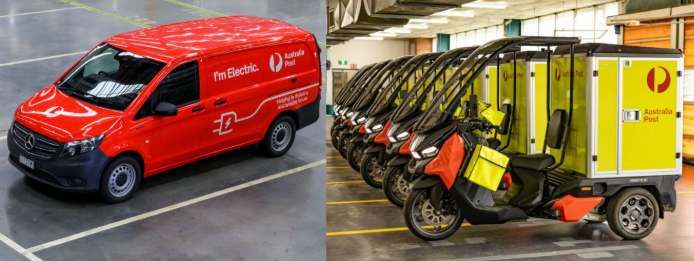
If you live in an Australian suburb, you’ve likely noticed the sound of your mail delivery has changed. The familiar, high-pitched whine of the old Honda "postie bike" is fading, replaced by the near-silent hum of high-capacity electric trikes.
But this isn't just a cosmetic rebrand for Australia Post. As we move through 2026, the organisation is deep into a multi-billion-dollar logistical gamble: proving that the nation's largest delivery network can actually run on 100% renewable energy without slowing down.
The End of the "Postie Bike" Era
For decades, the petrol motorbike was the symbol of the Australian postal service. However, the explosion of online shopping rendered them functionally obsolete—they simply couldn't carry the volume of parcels modern consumers demand.
Enter the Rapide 3. Australia Post has now deployed over 5,000 of these electric three-wheelers. The shift is practical rather than just performative; these vehicles carry 150 parcels at a time, roughly four times the capacity of the old bikes. By eliminating the need for posties to return to the depot for "reloads" mid-shift, the fleet expansion is actually streamlining delivery windows in high-density areas.
Heavy Hauling: The Mercedes-Benz Partnership
While the trikes handle the "last Km," the real challenge lies in the "middle Km"moving bulk freight between distribution hubs. This is where the fleet expansion gets serious.
Throughout late 2025 and into early 2026, Australia Post integrated dozens of Mercedes-Benz eVito vans into its metropolitan hubs. Unlike earlier EV trials that struggled with range anxiety, these units are backed by a massive rollout of 37 dedicated charging sites nationwide. By charging these vans with on-site solar (which the organisation is doubling to 30MW capacity), they are effectively decoupling their delivery costs from the volatility of global oil prices.
The "Hard-to-Abate" Challenge
It’s not all sunshine and batteries, though. Australia’s geography remains a brutal adversary for pure electric tech. For the long-haul treks across the Nullarbor or into the Red Centre, battery density isn't quite there yet.
To bridge this gap, Australia Post is taking a pragmatic, "bimodal" approach:
The Urban Core: 100% Electric (Vans, Trikes, and the new eActros trucks).
The Regional Long-Haul: A transition toward Renewable Diesel (R10), which cuts emissions by roughly 20% without requiring a total engine overhaul.
Why This Matters for the Consumer
This fleet expansion isn't just a win for the environment; it’s a buffer for the consumer. As fuel levies become a standard (and frustrating) addition to most shipping costs, Australia Post’s move toward a self-sustaining, solar-powered fleet offers a path toward more stable postal rates.
The goal for 2030 is clear: an 8% reduction in total emissions while handling more volume than ever before. It’s a high-wire act of logistics, but as the 5,000th EV hits the road this month, the "green" future of the Aussie postie looks less like a pilot program and more like the new standard.


Comments