

Used EV Battery State Of Health Revolution, now and in the future.

How to Check Battery Health, and Why Global Laws Are Forcing Car Makers to Clean Up Their Act.
Key points:
The Ultimate Risk: A used EV's biggest financial wild card is its hidden battery condition, representing the vehicle's highest replacement cost if defective.
The Transparency Gap: Hidden State of Health data creates severe buyer anxiety and penalizes private sellers with unnecessary third-party testing costs.
The Production Shift: Manufacturing economics mean Euro 7's mandatory on-board battery health tracking will inevitably become the global digital dashboard baseline.
The Future Standard: Standardizing open, untampered battery metrics protects used vehicle residual values and establishes universal consumer trust across the industry.
For decades, buying a used car meant checking the odometer, looking for oil leaks, and flipping through a stamped logbook. But as the world transitions to electric vehicles (EVs), the traditional pre-purchase inspection is undergoing a massive shift.
In an EV, the high-voltage drive battery is the lifeblood of the vehicle. It dictates your range, your charging speed, and represents up to 40% of the car's total value. Naturally, the number one question every used EV buyer and seller asks is: What is the State of Health (SoH) of the battery?
Unfortunately, most car manufacturers haven't made finding this number easy. Out of a fear of causing "degradation anxiety" among owners, many brands hide this data deep within the car's computers. Thankfully, you don't have to fly blind. Whether you want to do it yourself, hire a professional, or look to the future of car manufacturing, here is the definitive guide to checking EV battery health.
Part 1: The Step-by-Step Battery Health Checklist
If you are buying or selling a used EV today, you have three distinct pathways to verify the battery's true capacity.
Option A: The DIY OBD2 Flash Test
The quickest and most cost-effective way to get raw data straight from the car’s brain is to use an Onboard Diagnostics (OBD2) tool.
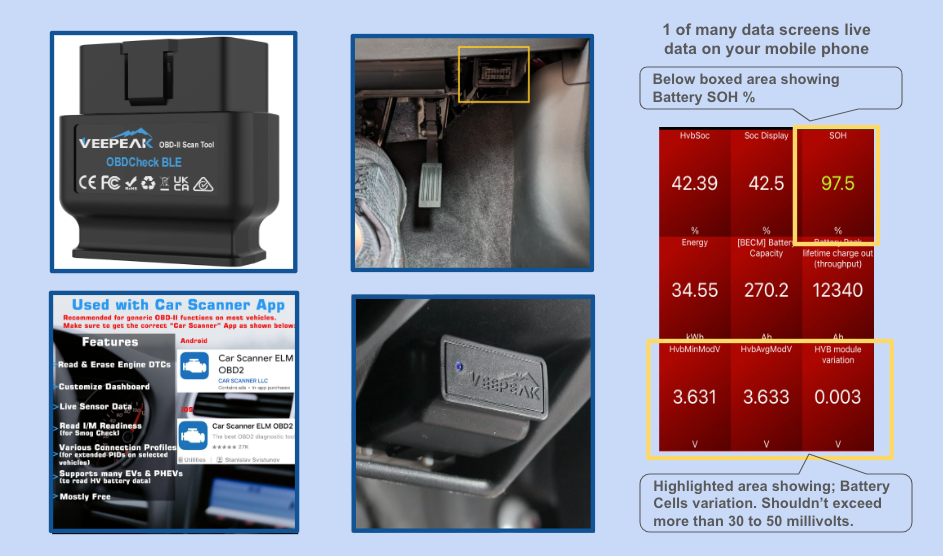
Step 1: Get the Hardware. Purchase a high-quality Bluetooth or Wi-Fi OBD2 dongle (available online or at auto parts stores).
Step 2: Locate the Port. Plug the dongle into the universal OBD2 port inside the car. It's usually located under the dash on the driver's side, near the pedals.
Step 3: Download a Dedicated App. Open a specialised EV logging app on your smartphone. Excellent vehicle-specific options include LeafSpy (for Nissan), SoulSpy (for Kia/Hyundai), Car scanner, which I utilise for various brands.
Step 4: Read the SoH. The app will pair with the dongle via Bluetooth and pull the exact "State of Health" percentage directly from the car's factory Battery Management System (BMS).
A step by step process utilising this method, article coming soon.
Option B: The In-Vehicle Deep Service Menu
Some manufacturers do include built-in tests, though they require knowing where to look.
The Tesla Method: In a Tesla, you can put the car into "Service Mode" via the center touchscreen. From there, you can initiate a Battery Health Test. The car must be plugged into a Level 2 home or public charger with a low battery. Over several hours, the car will fully discharge and recharge the pack, running a highly accurate calibration to output a definitive health percentage.
Option C: The Independent Third-Party Review
If you are sealing a commercial sale and want an unbiased, certified document that proves the battery is healthy, you can turn to independent testing networks.

Mobile Testing Services: Companies like NRMA or independent specialists utilise advanced hardware diagnostic systems (such as the European AVILOO system). An inspector plugs a telemetry device into the car, and either performs a rapid "Flash Test" or monitors the battery over a brief drive to generate an independent, certified State of Health certificate.
Specialist EV Workshops: High-tech automotive service bays (such as mycar or Infinitev) now utilise rapid data-analytics platforms like Voltest. They plug into the car and assess cell-by-cell balance metrics in under five minutes, giving you a comprehensive printout of the pack's structural stability.
While an independent third-party report is a fantastic asset for a buyer offering certified peace of mind before handing over their money, it introduces a significant friction point for private sellers. For an individual selling their car privately, this test adds an extra out-of-pocket cost running into the hundreds of dollars. Furthermore, it introduces a logistical inconvenience, forcing the seller to take time out of their day to book and attend an appointment that fits into a service provider's busy schedule.
To combat this hurdle, innovative mobile EV testing services are starting to emerge. By sending a technician directly to the seller’s home or workplace to plug in the diagnostic hardware, these services completely alleviate the inconvenience of losing a half-day at a workshop.
However, even with the convenience of roadside or driveway testing, the cost barrier remains a major downside for the everyday consumer. Paying a couple of hundred dollars just to prove a vehicle is functioning as advertised is a bitter pill for a private seller to swallow. This financial hurdle is precisely why a free, standardised, and built-in dashboard transparency mandate is the ultimate goal it completely democratises battery data for both parties at zero cost.
Part 2: The Blueprint for a Transparent Future
What OEMs Should Do For Customers
Relying on aftermarket dongles or hidden service menus shouldn't be necessary. Car manufacturers owe it to their consumers to make battery health as accessible and readable as a traditional fuel gauge or odometer.
Borrowing the transparent philosophy of the early Nissan Leaf but updating it for modern high-resolution screens, the ultimate, consumer-friendly OEM battery health display should follow a simple three-step procedure built directly into every vehicle's dashboard:
The One-Touch Dashboard Health Screen: Under a dedicated "Battery" or "Vehicle Status" tab on the main infotainment screen, a clear, unhidden State of Health (SoH) percentage should be visible at all times.
Real Usable Energy Metrics: Instead of just showing a generic percentage, the screen should show the exact kilowatt-hours (kWh) of usable energy remaining in the pack compared to when it rolled off the factory floor (e.g., "66.7 kWh usable of 75.0 kWh original").
Warranty & Structural Transparency: The screen should prominently display a countdown of the remaining battery warranty (e.g., “3 Years / 64,000 km remaining under factory warranty”) and a simple green/yellow/red health light regarding cell balance.
By making this standard, manufacturers would instantly erase the mystery of buying a used EV, stabilsing resale values and boosting consumer confidence.
Part 3: The Law Steps In
How Euro 7 is Forcing Global Transparency
Car manufacturers are no longer going to have a choice in this matter. The European Commission has officially stepped in with landmark legislation that completely changes the rules of the game for EV battery monitoring.
Under the newly implemented Euro 7 emissions and durability regulations, the European Union is treating battery degradation as an environmental compliance issue. Because building an EV battery requires significant resources, forcing cars to have long-lasting, durable batteries is critical to reducing overall lifetime carbon footprints.
The Euro 7 framework introduces strict rules that will fundamentally change how everyone interacts with a used EV:
1. Mandatory Minimum Battery Durability
Car makers must guarantee that their EV batteries meet strict longevity thresholds. If a vehicle drops below these numbers within the timeframe, it fails compliance:
After 5 years or 100,000 km: The traction battery must retain at least 80% of its original capacity.
After 8 years or 160,000 km: The traction battery must retain at least 70% of its original capacity.
2. The On-Board Monitoring (OBM) Mandate
Manufacturers are strictly forbidden from hiding battery degradation data. Euro 7 mandates the installation of live On-Board Monitoring systems that constantly track the real-world state of health of the battery.
Most importantly, this data must be accessible inside the vehicle to the consumer. Car makers are required to display this live battery health data transparently on the vehicle dashboard, or make it freely available via an accessible digital interface without requiring a trip to a proprietary dealership mechanic.
3. The Environmental Vehicle Passport (EVP)
Every new Euro 7 vehicle will come with a digital "Environmental Vehicle Passport." Accessible via a simple QR code or digital interface inside the car, this passport updates live with dynamic, vehicle-specific data. A buyer can walk up to a used EV, access the passport, and instantly see a certified log of the vehicle's lifetime energy consumption, electric driving range, and its exact, untampered battery State of Health.
The Global Ripple Effect
While Euro 7 is technically a European regulation, its practical effects are sweeping across the globe. Because automotive manufacturers build cars on standardised global platforms, it is highly inefficient for an engineering team to design a transparent, compliant dashboard for Europe, while simultaneously building a blind, locked-down system for other markets. Market forces and production line economics dictate that this transparency will become the global baseline. However, to permanently lock in this consumer right, local transport authorities worldwide MUST proactively integrate these State of Health monitoring standards into every country's design rules, ensuring car makers can never turn the feature off for local buyers.
As Euro 7 compliance deadlines roll out heavily into the market over the next few years, this level of open, clear battery health transparency will rapidly become the universal baseline for all electric vehicles worldwide. The "black box" era of EV batteries is officially coming to a close.


Comments